


Nestled between the Canadian Prairies and the foothills of the Rocky Mountains, Calgary combines a strong employment base with access to outdoor recreation, established neighbourhoods, and a growing selection of housing.
For homebuyers, understanding the cost of living in Calgary, AB, goes beyond the purchase price of a property. Mortgage payments, utilities, transportation, taxes, groceries, and other everyday expenses all affect the amount you need to budget.
This guide breaks down the major expenses involved in living in Calgary, Alberta, and explains what prospective homeowners should consider before making a move.
Understanding the Cost of Living in Calgary, AB
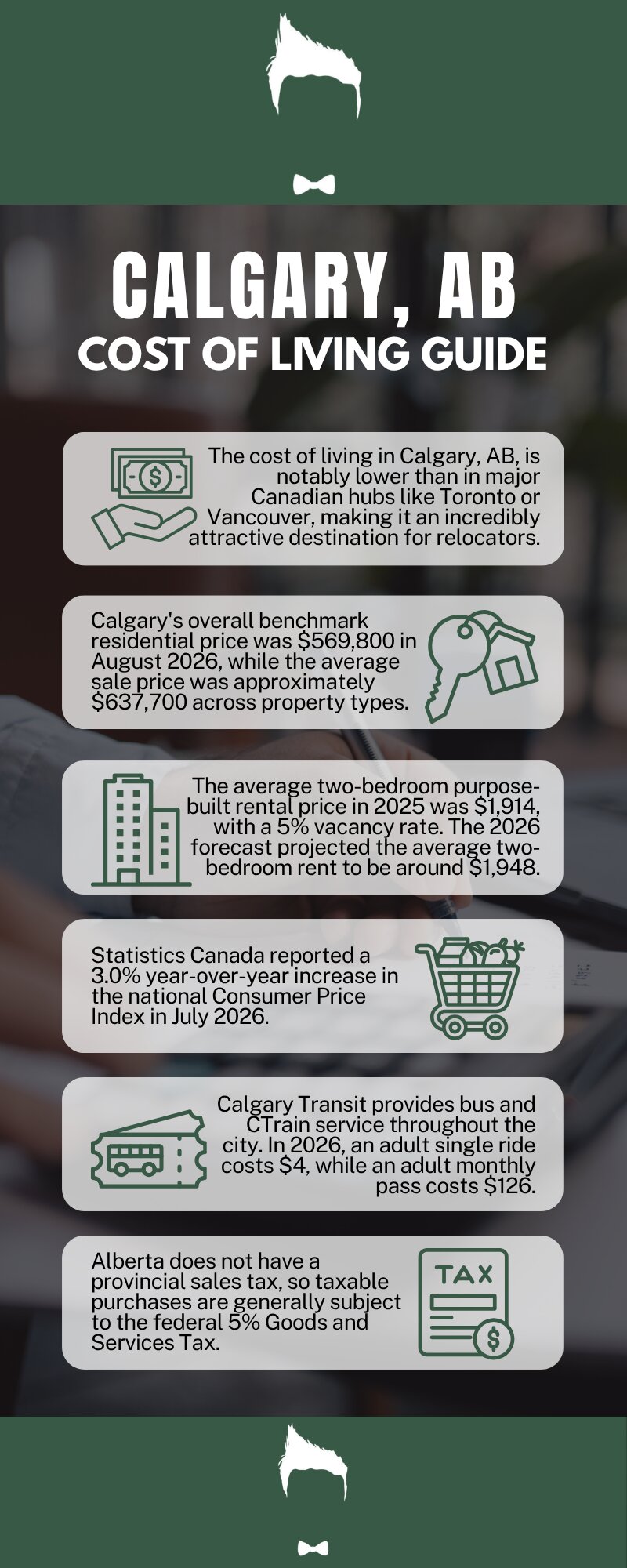
The cost of living in Calgary, AB, is notably lower than in major Canadian hubs like Toronto or Vancouver, making it an incredibly attractive destination for relocators. By using a comprehensive Calgary affordability guide, residents find that their dollar stretches significantly further, especially for everyday living expenses and local taxes.

Exploring Calgary Housing Costs and Real Estate
For many households, housing is the largest monthly expense. The good news for buyers is that Calgary offers a wide range of property types and neighbourhoods, allowing buyers to choose a home that fits their budget and lifestyle.
The broader Calgary affordability guide should therefore consider more than a single cost-of-living figure. Your household income, down payment, mortgage rate, commute, family size, and choice of neighbourhood can all substantially change your monthly budget.
Accessible Homeownership
Calgary housing costs remain an important reason the city attracts buyers from across Canada. The market includes downtown condominiums, established suburban homes, newer communities, townhouses, and larger properties on the city’s outskirts.
Calgary’s benchmark residential property price was about $569,800 in August 2026, according to the Calgary Real Estate Board. The average sale price was higher at approximately $637,700, demonstrating why buyers should distinguish between an average price and a benchmark price when researching the market.
Neighbourhood choice can make a substantial difference. A condominium in or near the Beltline may have a lower purchase price than a detached home in a newer suburban community, but condo fees need to be included in the ownership budget.
For families, communities such as Evanston and Mahogany offer different housing styles and amenities from the urban core. Buyers should compare not only prices but also property taxes, commute times, school access, maintenance requirements, and future development.
Rent vs Buy Dynamics
Renting can make sense for newcomers who want time to understand Calgary before purchasing. It can also be useful for buyers who are building a down payment or are uncertain about their preferred neighbourhood.
Rental costs have become more competitive as new supply has entered the market. CMHC reported an average two-bedroom purpose-built rental price of $1,914 in Calgary in 2025, with a 5% vacancy rate. Its 2026 forecast projected the average two-bedroom rent to be around $1,948.
Buying, meanwhile, introduces expenses such as mortgage interest, property taxes, insurance, maintenance, and possibly condominium fees. The advantage is that homeowners can build equity as they pay down their mortgage and benefit from any future property appreciation.

Analyzing the Calgary, Alberta Cost of Living
Budgeting for Daily Needs
When calculating the Calgary, Alberta, cost of living, it is important to account for expenses that can fluctuate throughout the year.
Utilities are one example. Calgary’s winters can be extremely cold, which can increase natural gas and electricity consumption for heating. A home’s size, insulation, heating system, windows, and energy efficiency can all affect utility bills.
Homeowners should also budget for property taxes, home insurance, repairs, and routine maintenance. These costs can be easy to overlook when focusing primarily on the mortgage payment.
Food and household expenses also deserve attention. Canada’s overall consumer prices continued to rise during 2026, although the rate differs substantially between categories. Statistics Canada reported a 3.0% year-over-year increase in the national Consumer Price Index in July 2026.
Transportation and Commuting
Transportation is another major component of the cost of living in Calgary.
Calgary Transit provides bus and CTrain service throughout the city. In 2026, an adult single ride costs $4, while an adult monthly pass costs $126.
Living close to a CTrain station or a major bus route can reduce dependence on a vehicle. Downtown residents may also benefit from Calgary’s extensive pedestrian network, including the Plus 15 system.
For households living farther from the core, however, owning a vehicle may be more practical. Buyers should account for fuel, insurance, financing, maintenance, parking, and seasonal expenses such as winter tires.

The Financial Benefits of Living in Calgary, Alberta
The Tax Advantage
One of the clearest financial advantages of living in Calgary, Alberta, is its lack of a provincial sales tax.
Alberta does not have a provincial sales tax, so taxable purchases are generally subject to the federal 5% Goods and Services Tax rather than a combined provincial and federal sales tax such as the HST charged in Ontario or several other provinces.
That difference can become noticeable over time, particularly for households making significant purchases after moving, furnishing a home, or completing renovations.
Homeowners should remember that the absence of a provincial sales tax does not mean there are no other taxes. Property owners still pay municipal property taxes, while income is subject to federal and Alberta provincial income tax.
Looking at the 2026 Market
The cost of living in Calgary, AB, in 2026 reflects both inflation and changes in the local housing market.
Calgary’s residential market has seen substantial construction and new housing supply. CMHC’s 2026 outlook projected approximately 22,000 housing starts in Calgary’s metropolitan area under its baseline scenario, while forecasting an average resale price of about $650,000.
Rental conditions have also been changing. CMHC reported that Calgary’s rental vacancy rate reached 5% in 2025 and expected further easing as additional supply entered the market.
For buyers, these conditions make it particularly important to look at current neighbourhood-level inventory rather than relying on a citywide average.

Navigating Calgary AB Living Expenses
Entertainment and Dining
Managing your Calgary, AB, living expenses does not mean giving up the city’s lifestyle.
Calgary offers professional sports, festivals, live entertainment, museums, restaurants, breweries, parks, and extensive recreational opportunities. Spending can vary significantly depending on how often you dine out or attend paid events.
Neighbourhoods such as 17th Avenue, Kensington, Inglewood, and the downtown core provide a broad range of restaurants and entertainment. Meanwhile, Calgary’s parks and pathways offer many low-cost recreational options.
The key is to treat entertainment as a discretionary part of your budget rather than a fixed cost.
Healthcare and Groceries
Healthcare is somewhat different from other monthly expenses because eligible Alberta residents can receive coverage for medically necessary physician and hospital services through the Alberta Health Care Insurance Plan.
AHCIP does not cover every healthcare expense. Prescription drugs, dental care, routine vision care, and several other services may require separate insurance or out-of-pocket spending.
Grocery spending, meanwhile, depends heavily on household size, dietary choices, shopping habits, and food prices. Rather than assuming groceries are automatically cheaper in Calgary, buyers should build a realistic monthly allowance based on their own household.
Calgary Cost Comparison Table
| Expense Category | Calgary Impact | Major Canadian Hub Comparison |
|---|---|---|
| Housing (Mortgage/Rent) | Wide range of options, with prices generally below Toronto and Vancouver | Generally lower than Toronto and Vancouver |
| Provincial Sales Tax | 0% provincial sales tax; 5% federal GST generally applies to taxable purchases | Higher combined sales taxes apply in several major provinces |
| Utilities | Moderate, with winter heating potentially increasing costs | Varies considerably by climate and housing type |
| Groceries | A significant recurring household expense | Varies by household and market conditions |
| Transportation | Moderate; lower for households able to use transit, higher for vehicle-dependent households | Varies by commute, transit access, and vehicle ownership |
| Healthcare | Eligible residents receive coverage for medically necessary insured physician and hospital services through AHCIP | Public healthcare systems differ by province |
Calgary’s housing advantage is particularly relevant for homebuyers. In August 2026, the city’s benchmark price was about $569,800, while Toronto and Vancouver continued to have substantially higher housing costs in their respective markets.
However, affordability should always be measured against household income and the specific property being considered. A lower purchase price does not automatically mean lower monthly costs if a home has high maintenance requirements, substantial condo fees, or a long commute.
Maximize Your Purchasing Power in Alberta
Understanding the cost of living in Calgary, AB is an important part of preparing to buy a home.
Calgary offers several advantages, including a diverse housing market, no provincial sales tax, extensive employment opportunities, and access to public transportation and outdoor recreation. At the same time, buyers need to budget carefully for mortgage payments, property taxes, utilities, insurance, transportation, groceries, and maintenance.
A useful Calgary affordability guide should therefore start with your total monthly budget rather than focusing on the purchase price alone.
If you are comparing neighbourhoods or deciding whether buying makes sense for your household, a local real estate professional can help you connect current property prices with your financial goals. Looking at the complete Calgary, Alberta, cost of living picture can make it easier to determine what type of property and neighbourhood fit comfortably within your budget.
If you are planning to buy a home in Calgary and want help understanding how current prices, neighbourhoods, mortgage costs, and Calgary AB living expenses fit into your budget, feel free to contact me at (403) 701-6358 or Ram@RamSund.com.
Frequently Asked Questions
Is the cost of living in Calgary, AB, lower than in Toronto or Vancouver?
For many households, particularly homebuyers, Calgary can be less expensive than Toronto or Vancouver because residential property prices are generally lower. The difference depends on the property type, neighbourhood, household income, and lifestyle.
What are the average Calgary housing costs for a single-family home in 2026?
There is no single citywide price that accurately represents every single-family home. Calgary’s overall benchmark residential price was approximately $569,800 in August 2026, while the average sale price was approximately $637,700 across property types. Detached-home prices vary considerably by community and property characteristics.
How does the Calgary, Alberta, cost of living impact everyday groceries?
Grocery spending is influenced by household size, shopping habits, dietary preferences, and changing food prices. Buyers should create a household-specific grocery budget rather than relying on a single citywide estimate.
What is the average cost of living in Calgary for a single professional?
A single professional’s expenses can vary substantially depending on housing choice, transportation, dining, entertainment, and lifestyle. Someone renting a room or sharing an apartment will have a very different budget from someone renting a newer downtown one-bedroom apartment and owning a vehicle.
Are living expenses in Calgary, AB, manageable without owning a car?
Yes, particularly for people who live near CTrain stations or well-served bus routes and work close to the downtown core. Calgary Transit charges $126 for an adult monthly pass in 2026. However, households living farther from employment centres or suburban amenities may find a vehicle more convenient.
How has living in Calgary, Alberta, changed for renters recently?
Calgary’s rental market has been moving toward more balanced conditions as substantial new supply has entered the market. CMHC reported a 5% vacancy rate for Calgary’s purpose-built rental market in 2025 and projected further increases in vacancy in 2026.
What should a comprehensive Calgary affordability guide include regarding winter utilities?
A realistic budget should account for higher heating requirements during Calgary’s coldest months. Utility costs can vary significantly according to home size, insulation, windows, heating system, thermostat settings, and energy efficiency. Buyers should ask for recent utility bills when evaluating a property whenever possible.